The New-Home Supply Cliff: Why 2027 Changes the Conversation
I recently read a report about the future supply cliff from Zonda. It is mainly about the new-home market — a different story from the resale market, but it gives us a different angle to understand today’s Greater Vancouver market.
The Q3 numbers
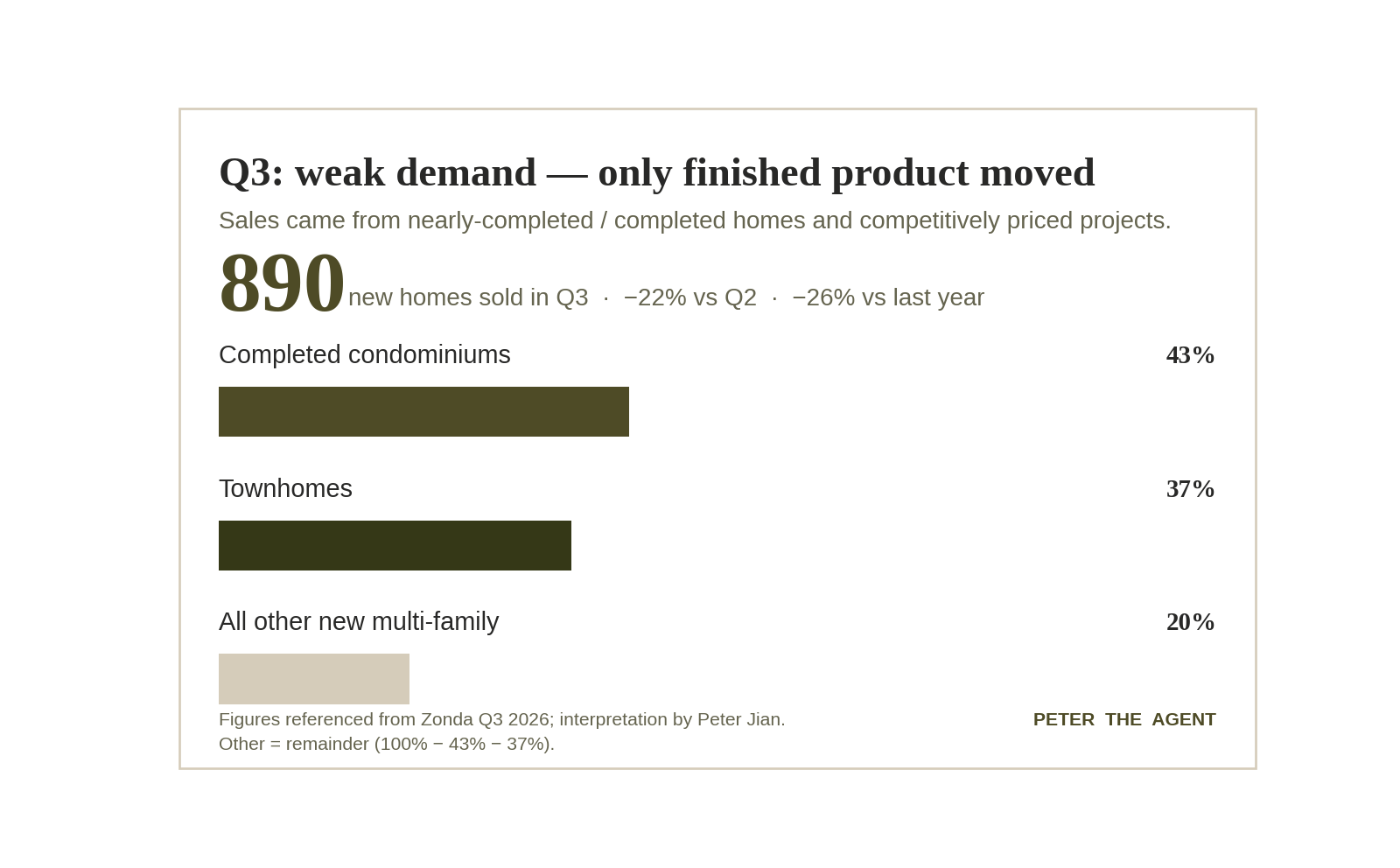
According to Zonda’s Q3 2026 data for Metro Vancouver, 890 new multi-family homes sold in the third quarter — down 22% from the previous quarter and 26% from the same period last year. Demand stayed weak through the summer and into the fall.
But look at what actually sold, and the picture sharpens. Completed condominiums made up 43% of those sales, and townhomes another 37%. Together, that is four out of every five new-home sales going to product a buyer can move into soon — or right away. The market is not buying promises right now. It is buying keys.
That pattern showed up across the region. In Richmond, Townline’s Luxe on Lansdowne drew buyers. In Burnaby, Shape’s City of Lougheed, Phase 1, Tower 3. In Surrey, Ansu Development’s Creekside Terrace — the closest of the three to my own backyard in South Surrey and White Rock. The common thread is not luxury or location alone. It is completion, and competitive pricing.
The pile keeps growing
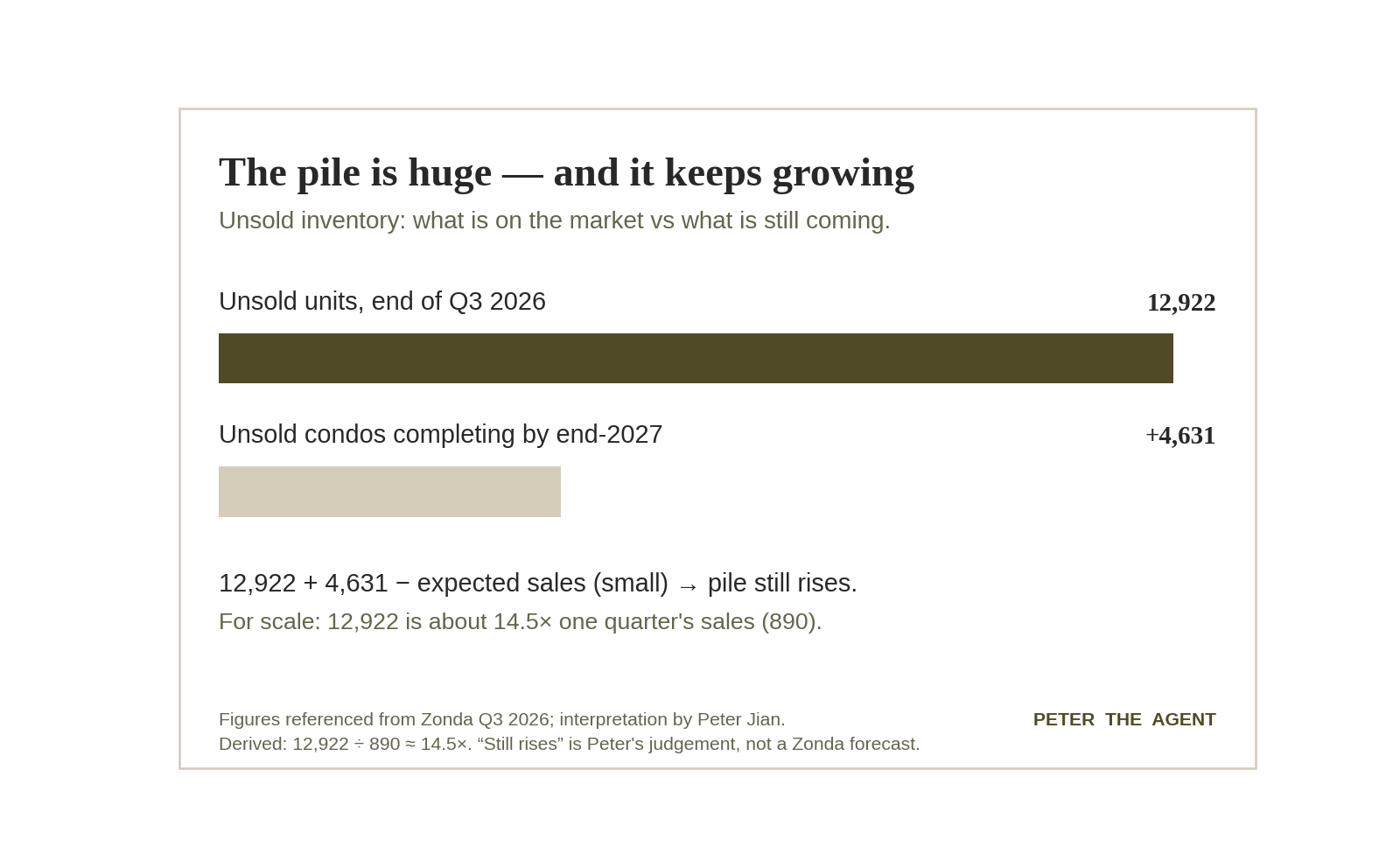
Now the number that frames everything else. At the end of Q3, an estimated 12,922 new homes sat unsold on the Metro Vancouver market. That is a huge number — about fourteen and a half times everything that sold in the entire quarter.
And the pile is still growing. Based on existing construction timelines, another 4,631 unsold condominium units are projected to complete by the end of 2027. Add those to the 12,922 already sitting there, subtract the small number that will actually sell between now and then — Q3 managed 890, and Q4 will not be much better — and the pile is bigger, not smaller.
This is the part most commentary skips: the story of the next year is not a shortage. It is an overhang that keeps building.
What the 40% really means — and the part that matters most
Zonda expects that “Beyond 2027, new home inventory is projected to decline by 40 percent reflecting a significant reduction of new inventory.”
What actually falls is completions, not inventory.
And here is the BUT, and it is the most important part of this article: even with 40% fewer completions, the number of new homes arriving still exceeds the number selling, because sales are so slow. So the unsold pile keeps growing anyway. That is a very bad combination — too much stock now, and no fresh supply pipeline for later. It is not a shortage story. It is a market with an overhang and no restart.
Nobody can promise you what that does to prices — anyone who does is selling you something.
What it means for resale buyers
If you are buying resale, this pile is your leverage. Every unsold new home is a seller you are competing against — not a buyer competing with you. Well-priced resale homes are still moving while aspirational ones sit, and that will not change while the overhang keeps growing.
You do not need to rush — and you should not assume waiting costs you choice, because the pile is growing, not shrinking. What matters is price: with this much unsold stock around, overpaying is the mistake, not waiting.
What it means if you own a presale or are thinking of one
If you already own a presale completing in 2027, your unit arrives into a growing pile, not a clearing market. That means more competing unsold units around yours at appraisal and at closing — which is exactly why mortgage planning needs to start early, and why you should talk to your lender about completion risk before the final year, not during it.
And if you are holding a presale you want out of, that pile is your competition too — my Sell page covers how I price against an overhang like this.
If you are considering a presale now, ask harder questions than you would have in 2021: what is the completion date, what happens if it slips, what does the assignment clause actually allow, and how does the price compare with a completed unit in the same neighbourhood today? If the answers are vague, the discount should be large. If they are precise, you may have found the exception that proves the rule.
Either way, this is a conversation worth having with numbers in front of you, not headlines. Get in touch and I will walk through your specific project or purchase — presale or resale — with the same homework I would do for my own money.